News
From wind tunnel testing to trusted performance: Validating aerodynamic tools for WPS

Alberto Llopis
Published
19 February 2026
The first article in this series explored why wind tunnel testing remains essential in the aerodynamic development of Wind Propulsion Systems (WPS). However, it’s not an end in itself. The real value lies in how the data produced can be harnessed to validate, refine and ultimately trust the advanced tools that underpin performance prediction. Tools that are absolutely essential to the wider adoption of wind at sea.
As wind moves from the realm of the early adopters into the wider commercial landscape, shipowners, operators and regulators need to know the real world impact of systems before they’ve actually deployed them in the real world. They need robust, reliable and proven performance prediction tools. It’s something bound4blue is committed to providing.
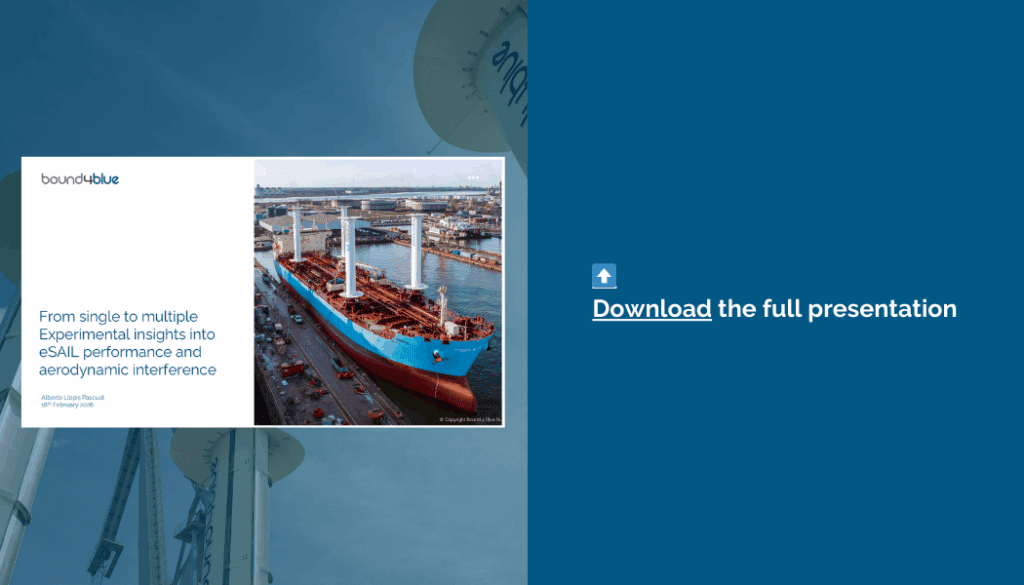
This piece delves into that quest, drawing on our paper presented at the RINA Wind Propulsion Conference (London, 17–18 February 2026), explaining how we utilise experimental testing data to fully calibrate and validate our proprietary CFD and POINT tools – ensuring you know exactly what to expect when deploying our market proven eSAILs®.
➡️ Download the full presentation ⬅️
Why tool validation matters for WPS performance prediction
WPS operate in complex, three-dimensional flow environments. Their performance depends on factors such as apparent wind angle, turbulence, vessel geometry and – increasingly – interaction between multiple sails.
Numerical tools like Computational Fluid Dynamics (CFD) and lower-order interference models are therefore indispensable. They are used not only during design, but also for performance prediction and optimisation, route analysis and energy savings assessments, and, crucially, regulatory compliance calculations (with particular refence to Pwind).
However, as with all walks of life, you need the right tool for the job. Fail to invest in a quality tool and you’ll fail to achieve the right results.
This reality steers our own development programme.
Continually tailoring tools for eSAIL® excellence
bound4blue has developed a dedicated aerodynamic modelling framework tailored to its unique suction sail technology. This framework combines two complementary tools:
- A high-fidelity CFD workflow for detailed flow analysis
- POINT, a fast interference tool designed to capture multi-sail aerodynamic interaction
Crucially, both tools have been calibrated and continually refined using dedicated wind tunnel data collected specifically for the eSAIL®. This makes their predictive capability inseparable from the experimental evidence behind them.
Rather than relying on generic aerodynamic assumptions, bound4blue adopts a continuous loop:
- Perform targeted wind tunnel testing
- Compare experimental measurements with numerical predictions
- Refine and recalibrate models where required
- Extend the validated range of operating conditions
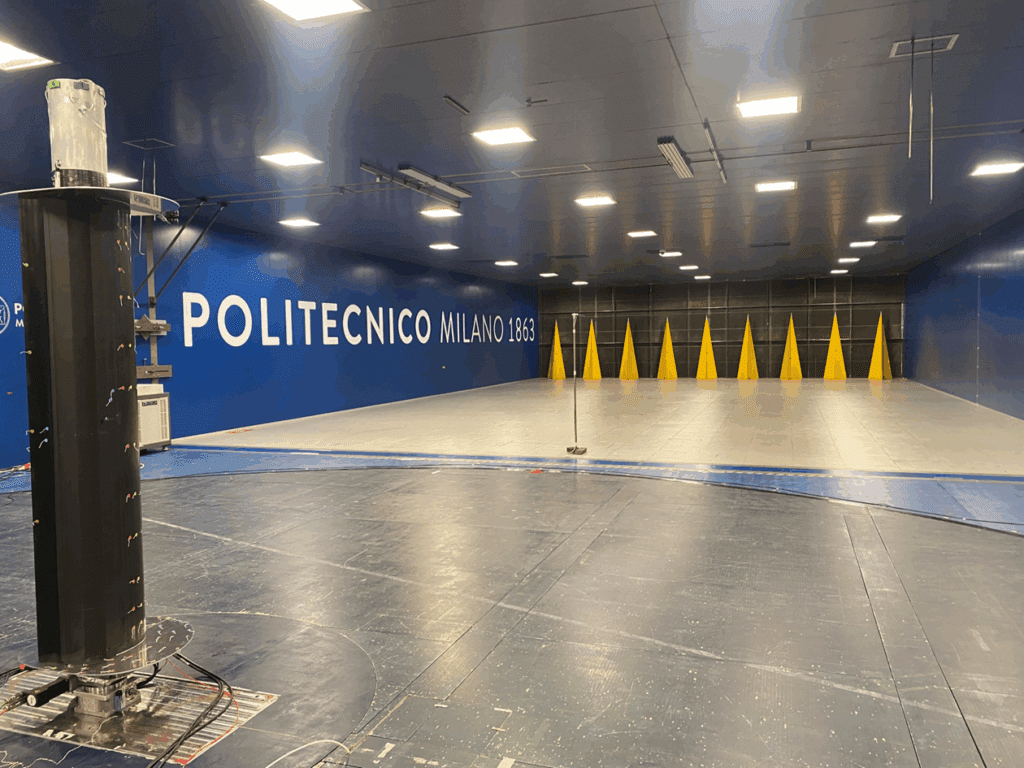
The April 2025 wind tunnel campaign at the Politecnico di Milano represented the latest step in this process.
Extending validation, building confidence
The campaign, mentioned in the first article of this series, was designed to extend validation in two important directions:
- More realistic conditions, including turbulent atmospheric boundary layers
- Multi-sail configurations, capturing aerodynamic interference effects
The tests covered both single-eSAIL® and two-eSAIL® arrangements, using a scaled model representative of bound4blue’s most widely deployed system, the Model 2 – 22m. This allowed the team to generate a high-quality dataset across a wide range of operating conditions, suction power settings and relative sail positions.
The purpose was clear: not to re-prove the concept of wind propulsion, but to verify and strengthen the existing calibration of bound4blue’s CFD and POINT tools.
Validating CFD: accuracy in action
CFD validation focused on detailed comparison between wind tunnel measurements and numerical simulations under carefully matched conditions. The CFD models reproduced the full wind tunnel test section, including the sail geometry, boundaries and suction system, ensuring consistency between simulation and experiment.
The results were striking.
Across all representative test cases, the comparison between measured and simulated pressure distributions showed less than 5% deviation, capturing:
- The suction peak on the sail surface
- The overall pressure distribution along the chord
- The sensitivity to angle of attack and operating condition
This level of agreement was observed not only externally, but also within the internal pressure field of the eSAIL® – a particularly important result, as suction performance is highly sensitive to internal flow modelling.
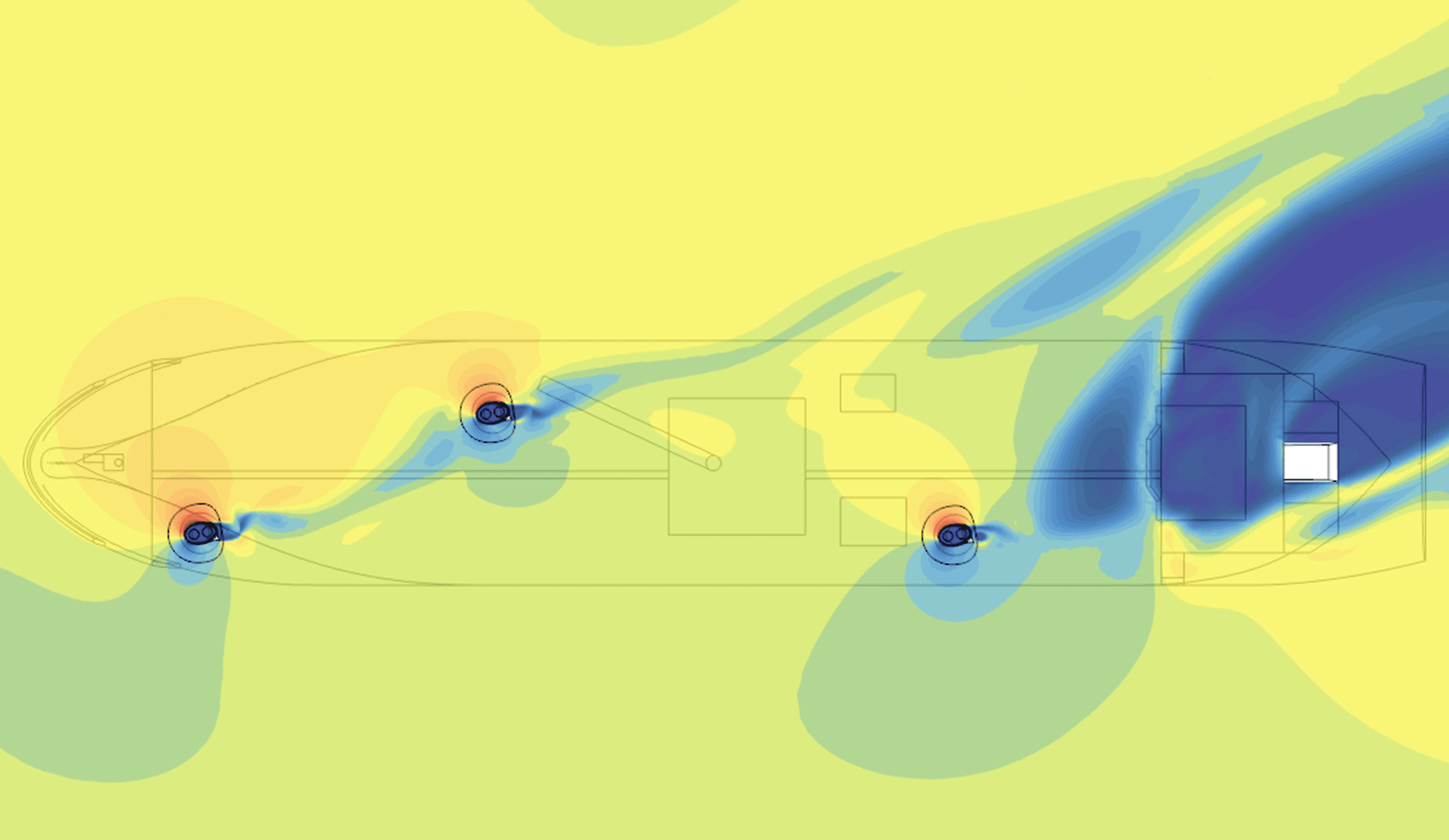
Beyond validation, CFD also provided insights that are difficult to obtain experimentally, such as wake development and downstream flow structure. These insights were used to inform the selection of interference test cases, ensuring that the wind tunnel campaign focused on the most relevant aerodynamic interactions.
Added complexity – from single to multiple sails
The majority of eSAIL® installations involve multiple units, so it’s imperative to test the tools on more than one standalone model. This is when things gets interesting.
The wake generated by an upstream sail alters the flow field experienced by downstream sails, affecting both forces and pressure distributions. That means you can’t look at one sail and simply multiply its impact by the number of installed units – a greater understanding is essential.
To address this challenge, the existing CFD framework has been invaluable in understanding multiple eSAILs in close proximity. The wind tunnel data provides an extra level of validation previously unavailable
The results again confirmed the integrity of bound4blue’s third party validated approach. Comparisons with wind tunnel data showed strong agreement for both upstream and downstream sails, demonstrating the model’s reliability in accurately predicting the key flow field features governing aerodynamic performance – even on multi-sail configurations.
Getting to the POINT: Fast, accurate, refined
While CFD provides high-fidelity insight, practical deployment also requires fast tools capable of evaluating eSAIL® configurations efficiently. This is where POINT comes in.
POINT is a low-order interference tool developed in-house by bound4blue to complement CFD. It enables rapid estimation of aerodynamic forces for multiple sail configurations, giving shipowners a fast and efficient method of assessing not just performance, but also commercial and regulatory benefits. It is, in short, an enabler for simpler, better and more informed eSAIL® adoption.
Before the 2025 campaign, POINT had already been calibrated using CFD and available experimental data. The new wind tunnel dataset provided the opportunity to test that calibration directly, without extrapolation.
Initial comparisons showed that the existing calibration already reproduced the main aerodynamic trends well. Minor systematic deviations at higher angles of attack were identified and addressed through small, targeted adjustments, rather than fundamental model changes.
The fine-tuning lead to POINT showing highly accurate agreement with experimental measurements, while retaining its computational efficiency – confirming that the tool is both robust and practical for operational use.
Confident conclusion
A key message from this work is that the accuracy of the results is not a generic property of CFD or interference models applied to suction sails. This is not a level of agreement that simply just ‘happens’. No, it is the product of years of focused development, calibration and validation using dedicated experimental data and passionate expertise.
For shipowners and operators, that long-term commitment translates into something truly tangible: confidence.
- Confidence that predicted fuel savings reflect real behaviour.
- Confidence that multi- eSAIL® installations perform as expected.
- Confidence that performance data used for compliance and reporting is robust and repeatable.
- Confidence in adopting this readily available, free and completely clean source of maritime energy.
With bound4blue’s continual focus on combining the experimental results of wind tunnel testing with ever more refined tools for calculation, we ourselves are confident of providing firm foundations for enabling the adoption of wind at the scale our industry needs to transition to greener operations.
The approach is validated, accurate and ready to help you achieve your commercial and regulatory targets.
We can help you set sail with confidence. Get in touch to find out more.
FAQ: Validating aerodynamic tools for eSAILs®
Q: Why is tool validation so important for wind-assisted propulsion?
A: Because performance predictions influence investment decisions, compliance assessments and operational planning.
Q: What level of agreement was achieved between CFD and experiments?
A: Across all pressure measurements, deviations remained below 5%, indicating very strong agreement.
Q: Why can’t generic CFD tools reproduce eSAIL® performance?
A: Because accurate modelling requires calibration against dedicated experimental data specific to the technology.
Q: What role does POINT play alongside CFD?
A: POINT provides fast, low-order prediction of multi-sail interference effects, complementing high-fidelity CFD.
Q: How does this benefit shipowners?
A: Validated tools reduce uncertainty, supporting confident decisions on installation, operation and regulatory compliance.